
7episode · full transcript
How Should Human Relationships Be?
The topic of the seventh circle was human relationships: how they shouldn't be, and how they should be.
short answer
The answer from the circle: human relationships should be aimed not at rising above one another or at self-interest, but at cooperation, thinking of one another and building connection. For that you first need to want a relationship, then learn to truly listen to one another. This happens not through coercion but through education.
Listenpodcast in Turkish · 26 min0:00 / 25:39
from the circle
How shouldn't human relationships be?
We live how they shouldn't be every day: aimed at rising above one another, at gaining advantage, at crushing others. Everyone has withdrawn into their own shell; we say "if it doesn't affect me, it's not a problem." Yet the source of all our problems, and of our happiness, lies in human relationships.
How should human relationships be?
First of all, there should be a relationship. Building relationships isn't a luxury; for humans, as social beings, it's a basic need. The rest is learned by trying: connecting by talking, not reacting on reflex. It doesn't happen through coercion; there's only one way left: education.
What does the circle teach us?
Someone who joins the circle sees that when they want to truly listen to someone, they can't; they filter even what they hear through their own thoughts. That's when the real question comes: how can I hear them now? We describe the method in the Circle Method guide.
Why is it so hard?
Because it goes against our nature; our mind is the mind of a world that says "take, care about no one, move on." But everything is connected: if we don't connect through right communication, nature binds us the other way round, through conflict.
Either the boat sinks with all of us, or we save the ship together.
— from the circle, 4:55
Full transcript
Episode 7 of Circle Talks; published on YouTube on September 21, 2026. The conversation is in Turkish and this is our translation. Tap a question to open its text; tap a timestamp and the video starts from that moment.
How was this text prepared?
The text was edited from the video's subtitles for readability: repetitions and unfinished sentences were removed, and a few short passages that couldn't be made out in the recording were skipped. Each paragraph marks the point where the word passes to the next person in the circle. Translated from Turkish.
question by question
question 1How shouldn't human relationships be?
We're going to talk about how human relationships shouldn't be.
We actually live how human relationships shouldn't be every day, and we never learn a lesson. To sum up: human relationships shouldn't be aimed at rising above one another, gaining advantage from one another and achieving things in life by rising above others. On the contrary, they should be aimed at benefiting the collective, at cooperation, at thinking of one another and building connection.
They should be aimed at building connection. All our problems come from human relationships; our happiness also depends on good human relationships. That's why human relationships should be above our ego, aimed at building a good connection.
Yes, because when it isn't so, we see what becomes of society. Recently I watched a video about Colombia and felt sorry for the people; maybe there are similar places in our country too. Seeing those neighborhoods I thought that this is where it ends up: a society where no one thinks of anyone, where everyone is addicted, chasing a few daily pleasures and able to harm someone for them. Frankly, as Türkiye we're also heading here, and unless there's real education there's nothing that can change it. Teach a child as much biology, chemistry, physics and literature as you like; once the neighborhood is like this, what does it matter that the child knows biology well? We've missed the most basic thing. We're still busy teaching children biology, whereas first we need to learn to be human.
Yes. Because of all that's happening, we need to feel a responsibility on ourselves. Everyone has now withdrawn into their own shell and no one cares about anyone else's troubles. We usually think "if it doesn't affect me, it's not a problem." That's not good. I need to feel responsible for everything going on outside and try to connect with others, to sit down and talk, so we can solve it. But unfortunately right now no one does much about what's happening outside, except maybe watching TV at home and complaining about things. Everyone lives in their own closed world, as if in closed cells. If we communicate rightly and start talking about how we'll fix these things together, we'll at least have taken a good step.
Actually we have no choice but to take this step. Because the human ego, the desire to receive, has grown coarser from generation to generation, by nature people don't want to build good relationships, good connections with others. That's why human relationships shouldn't run on autopilot; they shouldn't run from within the egoistic desire to receive. We need to develop human relationships above our ego, above our desire to receive.
Because nature is like this: if everyone is a right part of the ecosystem, the ecosystem goes on. If not, it becomes like today: "Will a world war break out?" The great powers have nuclear weapons and there's a huge unknown. If a war broke out it wouldn't be like before. A president who's been cornered, whose country is about to be lost and who has an atomic bomb could say "If I go, everyone goes." We're in such a situation that we now understand: either the boat sinks with all of us, or we save the ship together.
question 2How should human relationships be?
Our second question: how should human relationships be? Now let's look at it from a somewhat more positive side.
First of all, there should be a relationship. First we need to want to build a relationship. We see that no one wants to talk to anyone anymore; especially since the pandemic everyone has withdrawn even further into their shell. First we need to know that building relationships, right relationships, is necessary; that it's not a luxury, that as social beings humans need it at the foundation of life, and that it's good for all of us. With a desire to learn this, we can come together with other people who want to connect and learn together how to do it. We can't know without trying. By coming together, maybe making mistakes but at least wanting to, we can find the right setting in our communication.
The relationship we build here while talking about a shared topic also becomes a concrete example of the question "how should human relationships be?" How should they be? We should connect by talking. We should be on a shared frequency. There shouldn't be reflexive reactions in human relationships. They should be above our ego. How should I put it: saying "good morning" to your neighbor shouldn't be abnormal. We're at such a point that when you say "good morning" to someone outside, they look at you as if you'd spoken a foreign language. Humans are social beings; they need human relationships. We need to be aware of this and build good relationships.
So is there an example of this? Let's think: it seems there isn't one in the world. There isn't even a society close to it; even those that look closest are actually far away. The communists had such a dream; we talk about it all the time. According to that idea, for thousands of years one group has ruled over another; the means of production, money, property and power are in their hands. The solution is to redistribute this by force: everyone will take according to their need and give the rest to society. But we saw that this collapses. So the point isn't to do it that way. The point is education. I'm not saying "let's build an educated communism"; everything comes down to education, and it never works through coercion. How can we tell someone "Work all day until ten at night and don't eat anything except what I give you"? Without knowing their need, without ever feeling their world, we can't impose anything on anyone. Society doesn't work the way it is now, and it doesn't work that way either. Then what will we do? Neither that works nor this. If it goes on like this, we're heading toward the neighborhoods in that video, as a country and as a world. Where's the solution? We need to be in search of it. And that, as we said at the start, is education. I want to do something like this; we're also talking about it as a group: maybe those who listen to us want to learn the circle. "What is this Circle Method, how is it done?" Let's set up something among ourselves for this; those who want to join can come and learn together with us what kind of education we need to go through. Let's develop each other.
Yes, education really is important. We can achieve this only through education, through a change of consciousness that comes with conscious awareness. For this a person first needs to know themselves, realize that they're egoistic, examine themselves. Someone who joins a circle meeting can gain such awareness just by following the circle rules. When they want to truly listen to someone, they'll see that they can't. Because they're focused only on their own thoughts; when communicating with someone they feel only their own thoughts, look only at them, and can't hear the person in front of them, don't truly listen. Maybe if they open their ears a little they seem to hear something; but they pass that too through the filter of their own thoughts. No one truly opens their ears, their heart, to someone else. But with this Circle Method a person starts to learn it. First they see: "I'm like this, and being like this isn't good; because being like this I don't benefit society, I harm it." After gaining this awareness within the circle, they start to feel the need to communicate rightly themselves: "I can't listen to the people I talk to, I can't feel anything but myself; now how can I hear them?" This Circle Method we practice, this circle talk, really is a method that can be a light for the future, and we invite those watching us to practice it too.
To be honest, there's a need for a ground for relationships where people listen to each other, where a person feels listened to and isn't judged, where they connect by talking. And this ground is an environment where the Circle Method is practiced. We as young people are providing this environment. Whoever among those watching us wants to develop human relationships by talking, to build right communication between people, can join us. This process isn't something like "We know a lot, we'll teach you." Actually we're all learning together, all developing together.
Yes, I hope we'll soon build such a place; maybe on social media, a place where we can stay in touch. The basic question here is: other than being like a swaying leaf, what can I do in life? Is changing things really in my hands? Actually it is, because we have more influence on life than we think. Maybe I can't change much in my individual life, I might say "who am I"; but it's not like that. Three or five people join together and make a scientific revolution; three or five people talk and produce a masterpiece of a film. Things start from three or five people anyway. That's why this isn't a utopian dream; it's the only thing we need to do in practice and that's truly worth working on. Because biology and the like won't save us; we'll just make more advanced weapons.
If we look at our lives, we'll see that all of it is built on communication. We get up in the morning, sit down to breakfast, and at that moment our communication with other people begins. At work we're with people; in the evening we come home, we're with our family. Unless we live alone on a mountaintop, everything in life is built on communication; and even someone living there has to communicate with people in some way to meet their needs. Maybe the most important thing in life is communication. If we arrange it rightly, we don't know what kind of life awaits us, because we've never tried it. As was just said, in the whole wide world, in world history, we can't even find a right example. If we feel that this is truly important and learn here, in the circle, how to do it rightly, maybe this can be a revolution like all the other revolutions. Only through communication, right communication.
Indeed, there's human communication everywhere in life; communication matters wherever there are people. Frankly, people are connected to and dependent on other people while meeting their vital needs; that's why communication with them is very important. Moreover, the place where a person will be happy is right communication with other people. What a person needs is the touch of another person. I don't mean this physically: the conversation, the talk they have together, right communication. This comes up everywhere in our lives. That's why we need to research and think about how a right ground for communication can be created, starting with our country and for all humanity. Genç Pusula provides this ground for communication and relationships.
Yes. The point here is this: what we're talking about goes somewhat against our nature. Why is there no such example in the world? Because we don't want such a thing. We don't want it, but on the other hand we're unhappy. We have no interest in building right relationships, yet that's also the cause of our unhappiness: wrong relationships. First with people, then with all of nature and with life, our relationships are wrong. That's why we understand that to be happy I need to do something that goes a bit against my mind. Because my mind is the world's mind: "Take, care about no one, move on; steal, swindle." From trade to politics it's like this everywhere. We think we'll be happy this way; then we see people at fifty, rich, with a good job, but they don't know what to do, they haven't been able to build a family. This isn't only in fifty-year-old adults; it's seen even in children. There are middle-school-age children who haven't had anything big happen to them, who have no trauma, but who have lost the joy of living; we see it in our close circles too. It seems strange: how can this happen at this age? But the new generation perceives some things better; they notice that something is wrong, they're much more sensitive to it. It's as if this is related to humanity's development: the more developed we are, the more we feel that things are off track, and from this feeling we come to a need for change.
Yes, we need to realize that this is necessary; and that happens through education. Even just by watching these programs, a person will hear something they've never heard before. They may say "What does the relationship, the communication between people have to do with these problems?" But after watching one, two, three episodes, I'm sure what we say will make sense to them too, because it really is like this. Everything we talk about is the laws of nature and facts. When we examine the street a bit, take a short look where we're pointing, we'll see these are the causes of the problems; I'm sure everyone will agree with us on this.
Let's also look at it from this angle: one of the laws of nature is that everything is connected and interdependent. If we don't build a right relationship, a right bond, through right communication, then because everything is connected, nature will necessarily bind us the other way round. What does the other way round mean? Through conflict, negatively; wars and fights are actually a kind of bond too. That's why we need to sit down and communicate rightly so this law doesn't bring us to a bond the other way round. We see it everywhere: married couples too, if they don't sit down and communicate rightly, will build that bond by fighting. Here we want to arrive at right communication, and for that the Circle Method is of vital importance.
In fact, spouses bonding through fighting is the good scenario. The bad scenario is the relationship ending completely, that is, divorce. If we apply this to the world, its equivalent is civilization ending with an atomic bomb, us killing each other. On one side there's the law of nature: everything is connected and interdependent. On the other, if we don't learn from all the negatives, life may end. We show our foolishness in everything. As a child I loved science fiction series; in all of them the bad side, the invading force, was humans. Actually we're aware of what an absurd situation we're in. Even so, people can't stop themselves. It's like an addiction: the doctor tells a smoker "Don't smoke anymore, you'll die." You know how wrong, how deadly it is; but nature is like this, you can't stop yourself. Who are the people who affect life the most? Heads of state. They can't stop themselves either. It's natural for us, three young people without power, to talk about "let's share, let's build relationships." But when we have power, will we be able to say the same thing? This is exactly where education comes in: because education will change my nature, will be above my nature, I'll no longer act according to my own satisfaction, my personal goals and desires; then having power won't corrupt me either. We need to go through such a change that it reaches every area of society in the generations to come.
closingEducation is in young people's hands
Thank you. We've come to the end of our time; about half an hour, it was a good conversation. I hope we'll keep making these programs and set up a group on social media for those who want to listen to us and do the circle with us. Let's educate ourselves. This is in our hands, no one else's. Unfortunately in schools too most people are busy with their own troubles. Education is, once again, in young people's own hands.
Episodes close to this topic
-
 episode 5 · 12 min read · 18 min talkWhat Is the Circle Method and How Is It Practiced?The rules and steps of the method that teaches listening.
-
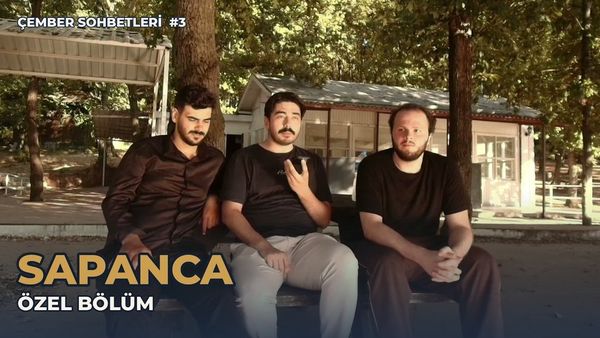 episode 3 · 17 min read · 21 min talkSapanca Special EpisodeTrue friendship and learning to get along.
-
 episode 4 · 18 min read · 32 min talkWhy Does Happiness Lie in Human Connection?The protective power of connection against anxiety.
circle rule
This conversation followed the Circle Method: no one interrupts anyone, there's no right or wrong, everyone speaks in turn.