
3episode · full transcript
Sapanca Special Episode
We held the third circle by Lake Sapanca, around a barbecue: disconnection from nature, true friendship, and why we make these broadcasts.
short answer
The answers from the circle: we feel disconnected from nature because we think of ourselves as its owner rather than a part of it, and we live with a desire that wants to receive only for ourselves. True friendship is seeing your friend's desire as your own; forgetting yourself among friends. And we make these broadcasts to show young people they're not alone and to learn again how to listen to one another.
Listenpodcast in Turkish · 21 min0:00 / 20:48
from the circle
Everything in nature is connected; why do we feel disconnected?
We think of ourselves not as a part of nature but as its owner. Nothing in nature exists only for itself; the only creature that harms others deliberately and arbitrarily is the human being. Neither moral lessons, nor meditation, nor forced sharing can rein in this appetite. The way out lies in our connection with each other; one person can't do it alone, it takes a community.
What is true friendship, and why does it matter?
A one-sentence rule: whatever you want for yourself, want it for others too. True friendship is a feeling; among friends a person doesn't feel themselves, like playing football in the neighborhood as a child. It's something we once had but lost. The four-minute short film of this round: What Is True Friendship?
Why do we make these broadcasts?
- To show young people they're not alone. Life doesn't have to run on autopilot.
- To introduce the Circle Method with a live example. In turn, without interrupting, without belittling anyone's opinion.
- To learn to get along. Young people, whose patterns haven't hardened yet, need to learn to listen to one another now.
We also explain our aim on the About page.
True friendship is such that when I'm among my friends, I shouldn't feel myself.
— from the circle, 10:44
Full transcript
Episode 3 of Circle Talks; filmed by Lake Sapanca and published on YouTube on August 21, 2026. The conversation is in Turkish and this is our translation. Tap a question to open its text; tap a timestamp and the video starts from that moment.
How was this text prepared?
The text has been edited for readability: repetitions and unfinished sentences were removed, and a short off-air exchange was left out. Each paragraph marks the point where the word passes to the next person in the circle. Translated from Turkish.
question by question
openingA circle in Sapanca
Hello, everyone. Lake Sapanca is in front of us; we've gathered to do a Circle Talks broadcast together. We know our circle rules: we talk around a shared question, answers are given to that question, one topic is discussed. No one interrupts anyone, no one says "I agree" or "I disagree" to anyone. Everyone's opinion is very important.
question 1Everything in nature is connected; why do we feel disconnected?
Our first question: when everything in nature is connected and interdependent, why do we feel disconnected? We'll go around twice.
We feel disconnected because we act as if we were not a part of nature but its owner. In our perception, in our ego, it feels as if we own nature: I'll use the animals and the resources however I like, exploit nature, stand above it, control it; this is my territory. Yet within all that cooperation, bees carry pollen along with other creatures; underground there's a network formed by fungi; in a forest all the trees are in communication with each other. There's an ecosystem, but humans see themselves above this ecosystem and destroy it. Humans are essentially responsible for many fires and disasters too. The thought "we own everything" is a sick thought; it cuts us off from nature and breaks the whole system.
Yes, we really are breaking the whole system. Another thing that causes this is the troubled bond between people. To be stronger than others, people dig up mines; to be stronger than others, to control them, to stand above them, they're ready to do every kind of evil, to harm other people and all of nature. Unless they do the opposite, it's impossible for them to unite with others, to connect. So it brings nothing but harm.
It does harm, because human nature is an egoistic desire to receive pleasure. In nature nothing sustains its existence for itself. The fruit on the tree isn't for the tree. Even a lion, when it hunts a zebra, picks the sickest, weakest one and hunts only to keep itself alive. But the human is the only being that harms others deliberately, arbitrarily, egoistically, selfishly. That's why, when everything in nature is connected and interdependent, humans feel disconnected.
Then the question is: our evil is plain to see; if not now, one day it will be plain to everyone. What will we do? Shall we climb a mountain, go to a monastery and meditate, sit cross-legged and calm ourselves? Would doing that make the world a better place? No. Why? Because today we look at the leaders of those teachings, and they break even their own teachings. Stopping ourselves isn't really in our nature; our brakes are broken. In our country the agenda is constantly fraud, theft driven by greed for power and position, corruption. Because no one can stop themselves. If I'm heading toward a position and a group of people are applauding and flattering me, there's no one left who can stop my ego; not even me. If I want, I meditate in the morning and keep defrauding people in the evening. Neither good morals, nor worship, nor meditation, nor any teaching will push us to become a good society. Because our nature's appetite, its urge to steal and take from others, can't be reined in by any method put in front of it. We can only rein it in through our connection with each other. If I exist through a truly right relationship among us, as a properly arranged part of a properly arranged society, I can do something other than steal and grab and disgrace myself and my life, and truly find a right place in nature. I can say, "I didn't choose my own name; even my thoughts aren't mine; I took them first from my mother and father, then from school and my surroundings, and became this character." But that doesn't mean we're doomed to be like this. I only need a right environment and a right place in it to position myself. We need a right society. This isn't something one or two people can do; we need the whole society. And it won't happen through dreams that impose sharing either. Say we said "we're egoists, we'll become altruists," joined a party and took power twenty or thirty years later; even if our own life were good, a very bad life would await the next generation. The examples are the Soviets, North Korea, Cuba: oppression. Telling our nature "take only as much as you need and give the rest, that's what's moral" or "sit and meditate, be of good morals, you'll go to heaven" doesn't hold, and it won't. That's why the only thing we can fix is truly good connections and a collective bond.
Yes, a person wants to be happy in this life and seeks happiness in everything; that's all the motivation that drives them. They look for a place where they can feel comfortable and happy. But in the current order we can only get happiness by crushing others, rising above others, taking what belongs to others; that's how people build themselves a life. If they built a new reality, the complete opposite of this, they wouldn't lose their happiness. No one is telling them "be unhappy"; a person doesn't have to be unhappy. But they need to change their method of being happy. Likewise their method of solving problems: not by running from problems or destroying, but by connecting, all together, solving them as a society. Our ancestors, the old Turks, would sit cross-legged in a circle just as we're sitting now and decide together, as a society, what they'd do and how they'd move forward; perhaps in small communities. Maybe this is what we need, to remember this again. Maybe this was what was right.
Yes, like the old Turks, like our ancestors, going around in a circle by the fire in the camp and talking. Our problems get solved by talking like this. If we recall the question of our session: when everything is connected and interdependent, why do we feel disconnected? Because we don't live in accordance with the laws of nature. Nature's law is this: in nature nothing takes something for itself egoistically, selfishly; it is always giving and takes only as much as it needs. If a person, too, takes what they need and spends the rest of their talent and time giving to society, they'll have lived in accordance with the laws of nature and will in fact see that the whole of society looks after them too.
question 2What is true friendship, and why does it matter?
We completed the first question in two rounds. Our second question: what is true friendship, and why does it matter?
There's actually one sentence that sums up true friendship: don't do to others what you wouldn't want done to you; do what you'd want done for you. That's it. Whatever you want, want it for others too. That's true friendship, but it's very far from us. Because the whole modern world, the capitalist world, every advertisement tells you "if you want to feel good, you need to buy this, this and this." None of them says that thinking of someone else will make you happy. Because the one selling you the product is also thinking "let me sell lots of this product, get very rich, and be happy that way." The basic thing here is to understand, once, how far we are from these concepts. In today's world we're very far away; so far that we don't even feel the lack, and we look for the problem elsewhere. We try to fill different voids with material things. But that isn't our real need.
If we go down this road, a person's mind doesn't even grow up. Let's speak openly: when I was five I had a toy, a boat. My friend had a toy ferry. I ask my mother: "Why don't I have a big ship like his?" Then a person grows up, becomes a rich businessman, and with the same logic looks at someone else's ship and says "why don't I have this?" Looking at him he seems like a very big man, "Mr. So-and-so, Mrs. So-and-so" come to the gathering; but the mind is the same. The mind of a five-year-old child: he wants a big ferry, he wants a toy. He'll get on it, travel around, enjoy himself; and the enjoyment he gets is at most sex and drugs. As if there's nothing else in life.
True friendship is such that when I'm among my friends, I shouldn't feel myself; I should be within the feeling of the bond between us. You've all experienced this. Go back to your childhood: when you played football with your friends in the neighborhood or spent time with them, you weren't even aware of yourselves; everything just flowed. True friendship is a feeling like this. A bond built without thinking of yourself, without carrying any worry about yourself, finding happiness only in the bond of love between you. Why does it matter? Because we need it. We once had it but lost it; we need to regain it. We can reach real happiness and the solution to our problems only this way.
True friendship is not doing to others what you wouldn't want done to you, and seeing your friend's desire as your own and making an effort to fulfill it. That is, a friendship where you build a right bond between you and feel that friendship. Let's hope we can always feel this friendship, and that our people take it as an example.
question 3Why do we make these broadcasts?
We went around each of the two session questions twice. Now we'll go around our third and final question twice. Lake Sapanca is in front of us; in a picnic mood we lit our barbecue, ate our meal, and we're going around the circle among ourselves. Our question: why do we make these broadcasts, these Circle Talks?
The reason is simple and meaningful. We look at our elders' way of life, the meaninglessness they've fallen into, their not knowing what to do. We're not like that: we have a purpose in life, an aim and discipline; we look at life from a certain perspective and arrange ourselves accordingly. We do this to be an example to other young people, to tell them about it. Because many young people use antidepressants, many have psychological problems, they're lonely. They shut themselves off with films, series and video games, or with drugs; some shut themselves off with certain groups. In this situation, how do we protect our mental health, how do we approach life rightly? Life has an effect on us; what should our effect on it be, so that in the lifetime we live we become a right and balanced part of nature? We're searching for this. What we want to pass on to young people is that life doesn't have to run on autopilot. Instead of places where everything is meaningless and temporary, where I shut off my mind and run away, there is a place where I can truly position myself rightly. We're trying to find it, thinking about it among ourselves, racking our brains; and we invite young people to this, and to talk about their own problems together. We want to tell them "you're not alone." A hundred years ago, together with Atatürk, a people escaped from a collapsing empire and from colonization; if we, like them, joined hands and put stupidity aside, if we learned to listen to each other and think rightly, gathered in our heads what we heard and built an environment where we could talk truly sincerely with each other, we could change everything. We want to pass this on.
Yes, along with this we want to create a good environment. We ourselves live within this environment and share it with you transparently. We experienced everything we talked about today ourselves; as three friends, three companions, we had a barbecue together. Right now we're in a very beautiful place, in the middle of nature, and the only thing we're focused on is how we can connect better. From this connection, as we're doing now, we want to reach you, show this as an example, and include you in it too. We want everyone to be included, to become one huge circle. Everyone can do this; what we're doing isn't hard. Having a circle talk is actually very simple: listening to others, truly listening to what others say, trying to join in, and talking without rising above anyone. This right kind of conversation could be the solution to all our problems. It really is that simple. It can be a means for us to build a real bond, and it is; we're living witnesses of this. We're experiencing it and passing it on to you this way.
In addition, we make these broadcasts to show a live example of the Circle Method, to introduce the method to the public. There's a question; around that question we each say our own thought to the center of the circle, in turn. No one interrupts anyone, no one belittles anyone's opinion. We want the Circle Method to spread well, especially among our young people, so that we can connect rightly and solve our problems by talking, with the Circle Method.
One more round on the same question: why do we make these broadcasts? Because we want to be able to get along. Yesterday I watched a video from parliament. A man of forty, fifty, sixty goes up to the podium and says to the other, "In your speech you said this about the flag, you can't say that"; the other answers, "That's not what I said, I meant this." These are the people running the state; your representatives and mine. "You said that, he said this; we're good people, they're bad." As if the country's problems aren't being discussed; it's like children fighting over "you said this, I said that." Then in the Grand National Assembly of Türkiye grown men punch each other; if it were a comedy film you'd laugh, but it's real. Things like this happen every year in our country. If we don't want the people running the state to still be punching each other in parliament like in an arena a hundred years from now, we'll learn to get along. How will we listen to each other, how will we understand what the other person wants without seeing them as an enemy? Because that's the first thing the animal ego does: "If it's against my interest, it's the enemy; attack, destroy, and if it's strong, run." That primitive. We need to learn how to break away from this and build a shared, mutual responsibility, how to listen to each other. This is very critical; so critical that grown men don't know it, they never managed to learn it. We as young people can't grow up like this. If we go on like this, two hundred years from now maybe they won't punch each other in parliament, but worse things will happen; that's the direction. People go up to the podium and speak only with hatred; there's no unity. If we go on like this, we'll miss the state we're in today. So, like the three young people here, as thirty, three hundred, three thousand young people, we first need to settle our outlook on life and our approach to each other among ourselves. It's much harder for adults to do this than for us, because the patterns in their heads have hardened into stone; they too will have to learn this one day. But we must now educate ourselves in this and show ourselves, the adults and the next generation that we really are a different generation.
This is exactly where we come in as a new alternative. In fact we're trying something new: something everyone knows, right in front of their eyes, but that no one has tried. Listening to each other, trying to understand each other, being able to act together; living in harmony without creating problems, maybe even solving others' problems. For us this is a new way of life, a way of life outside what we're used to. It will change how we look at the world and how we approach each other. That's how the world will change too. Nothing in the world will change by itself; the world will change to the degree that our approach changes. That's why, to fix how we approach people, to be able to become a community, a society, a nation, a family, call it a community sharing the same apartment building, call it a family, call it a nation, to be a community of human beings, using the Circle Method is essential. Here, keeping the circle rules as best we can, we're connecting by talking among ourselves, and we want to show our people that problems are solved this way. Frankly, this is how a conversation should be had, how talking should be done, how decisions should be made. Our broadcasts will continue to show an example of this.
closingFarewell from Sapanca
Thank you so much for watching. We're in Sapanca right now; it was a beautiful day. Bless you all for your words and your hearts. Goodbye.
Episodes close to this topic
-
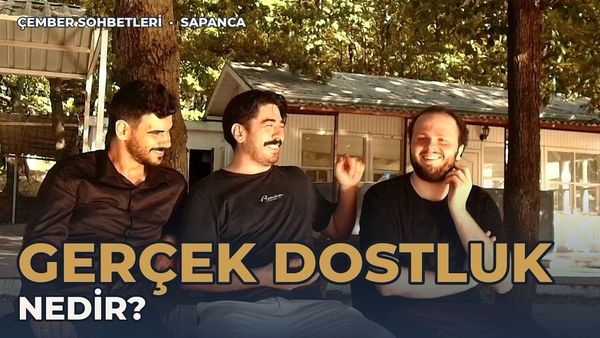 short film from Sapanca · 2 min read · 4 min talkWhat Is True Friendship?A four-minute short film from this circle's friendship round.
-
 episode 7 · 16 min read · 26 min talkHow Should Human Relationships Be?How should human relationships be?
-
 episode 1 · 13 min read · 23 min talkWhy Aren't Young People in Türkiye Happy?Why are young people lonely and unhappy?
circle rule
This conversation followed the Circle Method: no one interrupts anyone, there's no right or wrong, everyone speaks in turn.