
5episode · guide and full transcript
What Is the Circle Method and How Is It Practiced?
A conversation method in which a community talks around a single question, in turn, without anyone being interrupted.
short answer
The Circle Method is a conversation method in which people who come together talk in turn around a single question. While one person speaks, the others only listen; no one interrupts anyone and no one tries to be right. The aim isn't to win the argument but, with everyone's contribution, to reach collective wisdom.
Listenpodcast in Turkish · 18 min0:00 / 18:11
in this guide
What is the Circle Method?
In the Circle Method, the word passes from one person to the next in turn, and everyone answers the same question. No one lectures anyone; everyone leaves their own thought in the middle of the circle. In episode 5 of Circle Talks, one participant described it as "a method in which people step out of their individual ego and solve their own problems together, with collective wisdom."
What sets the method apart from an ordinary conversation is where attention goes. When talking in a group, a person usually focuses only on what they themselves are going to say. In the circle, they listen until it's their turn and focus on the thought of the person speaking. The same question goes around more than once; each speaker completes what the previous one said.
The three rules of the Circle Method
- No one interrupts anyone. While one person speaks, the others only listen.
- There's no right or wrong. No one tries to win the argument; everything said is left in the middle of the circle.
- Everyone speaks in turn. The word goes around the circle and reaches everyone; no one is left out.
Because the rules are the same for everyone, participants don't worry about how what they say will be received. We remind everyone of these three rules at the start of every episode.
How do you practice the Circle Method? Step by step
- The community decides together. A circle can't be done alone. Everyone who'll take part must agree together to practice the method and keep its rules.
- A single question is chosen. The whole round turns around that question: "What is true friendship?", "Why aren't young people happy?" and so on. In Circle Talks most episodes turn around three questions.
- The speaking order is set. We go in alphabetical order. What matters is that the order is clear to everyone from the start.
- Everyone speaks to the middle of the circle. Words are addressed not to one person but to the community. Instead of opposing the previous speaker, each speaker completes what they said.
- The question goes around several times. The same question is returned to more than once; in each round everyone speaks again.
- The circle closes with a round of impressions. In the last round, everyone briefly says what has stayed with them from the conversation.
What is the Circle Method good for?
These are the benefits that stood out in episode 5:
- Many-sided thinking. Everyone looks at the same question from where they stand, and sides that no single person could see come to light. In one participant's example, ten ordinary people who practice the method correctly can reach a better result than one very clever person alone.
- Solutions without conflict. Problems are solved by talking instead of through conflict and violence. Scientists, politicians or the residents of a neighborhood can come together with the same method.
- Expressing yourself freely. Because the rules protect everyone, no one holds back thinking "what will people think of me"; a person gets the chance to show their qualities.
- Building connection. Because everyone focuses on someone else, a wholeness forms. Participants leave the circle happy and want to come together again.
Everyone brings half a penny, and in the middle it becomes a wonderful feast.
— from the circle, 8:14
Who can practice the Circle Method?
Anyone who wants to keep its rules. The method can be practiced in a family, at school, at work or in a neighborhood; we also talked about this in the episode on how human relationships should be. It can be used to reach a shared decision, or simply to talk.
The only condition is being willing. Even someone who thinks they can't do the circle learns over time once they start trying sincerely: they get used to listening to others and silencing their own thoughts for a while. In the words of episode 5, "the circle will educate them."
Is the Circle Method the same as the "circle technique"?
No. Although their names are similar, they're used for different purposes. The method known in Turkish education as the "circle technique" is a classroom discussion technique: students sit in a circle, a leader runs the discussion, a secretary notes the views, prepared questions are put to each student in turn, and if the right answer isn't reached, hints are given.
In the Circle Method there's no debate and no single right answer being sought. No one runs the conversation or evaluates the answers. The aim isn't to teach a subject but to reach collective wisdom with everyone's contribution and to build connection by talking. What the two share is the circle form and the word going around in turn.
| Circle technique (in education) | Circle Method | |
|---|---|---|
| Aim | To teach a subject through discussion | To reach collective wisdom, to build connection |
| Who leads | A leader runs it, a secretary takes notes | No one runs it; everyone gets an equal turn |
| Answers | The right answer is sought, with hints if needed | There's no right or wrong |
| Where | In the classroom | In families, schools, workplaces, any community |
Full transcript
Everything in this guide comes from episode 5 of Circle Talks, broadcast live on YouTube on September 4, 2026. Below is the transcript of that conversation; the conversation is in Turkish and this is our translation. Tap a question to open its text; tap a timestamp and the video starts from that moment.
How was this text prepared?
The text has been edited for readability: repetitions and unfinished sentences were removed. Each paragraph marks the point where the word passes to the next person in the circle. Translated from Turkish.
question by question
question 1What is the Circle Method?
The Circle Method is a method in which people step out of their individual ego and solve their own problems together, with collective wisdom. Everyone is included in everyone; everyone takes from everyone and everyone can give to everyone. Rather than a one-way conversation where one person tells another something, it's a method in which everyone is enriched.
The Circle Method is a method in which a person dissolves themselves within the community. A person adds their thoughts here, not because they value their own thought, but because they want society's thinking to advance by contributing to society. In other words, it's the method in which everyone talks in turn, with collective wisdom, around a single topic: the one we're practicing right now.
In this method everyone is very important. Everyone is equal, and everyone focuses on someone else, on their thoughts.
If you really want to talk a topic through, this is the best method. It's as if a person isn't talking but is inside an experience, a network. They don't come out as the person who went in; this method turns a person into someone entirely different.
Normally, when chatting in a group, a person focuses only on what they themselves will say and stays limited to their own feelings and thoughts. But when a topic is discussed within the circle, they manage to step outside their own limits and take part in others' thoughts. The bigger the circle, the bigger the thought they find themselves in.
In addition, the Circle Method is a method in which people complete each other while talking in turn about a single topic, the same topic goes around more than once, and connection is built by talking.
question 2What is the Circle Method good for?
In the Circle Method everyone steps out of their individual ego, their desire to receive, and gathers in a shared consciousness; they speak to that shared consciousness and contribute to it.
It makes everyone feel everyone. A person who practices the Circle Method discovers that there's actually no up, down, right or left. You can't tell that from the shape of a circle: turn the circle a little and up becomes down, right becomes left, everything changes. The circle is the best method for a person to get to know their surroundings and themselves. If a person wants to know themselves, they should practice the Circle Method.
At the same time it enables many-sided thinking. We can solve our problems by talking around a circle. Scientists can come together and talk about their work around a circle; politicians can talk with a circle; people in a neighborhood can talk about the neighborhood's problems around a circle. Because otherwise we go nowhere but to conflict and violence.
Imagine one person with a high IQ and ten ordinary people. If those ten people practice the Circle Method correctly, they can reach a better result than the one person.
The Circle Method gives us a way to talk about a topic as a community.
Because there, nothing is individual anymore. Everyone focuses on someone else and a wholeness forms. Within that wholeness everyone becomes happy, leaves happy and wants to connect again.
In the Circle Method a person can also bring out their qualities. In groups out on the street people struggle to express themselves, because what they focus on is "what will people think of me, what effect will what I say have on the other side." In the circle, though, a person says what they say only to benefit society, and they know that, by the circle's rules, no such reaction will come back. Thanks to this they express themselves freely and get the chance to bring out their qualities in a way that benefits society.
Because while practicing the method, a person is sure that everyone is keeping the circle rules. Because everyone speaks to the center of the circle and serves a shared community, each gives that special thing they have. Everyone brings half a penny, and in the middle it becomes a wonderful feast. That's exactly what the Circle Method is.
question 3Who can practice the Circle Method?
All of society can practice it: in the family, at school, at work. Because it offers a shared solution and everyone is both happy and in wholeness, it benefits everyone.
The circle doesn't choose anyone; it includes everyone. It's enough just to fit in with the circle, to be part of it.
Maybe the question should have been "who can't practice it." Anyone who wants to keep the circle rules and talk within them can practice it. In families, in schools, in companies, everywhere, people can talk around a given topic through this method; to reach a shared decision, or simply to talk. What matters is wanting to.
Anyone who wants to can practice it. Because in this method everyone is equal, everyone is very important. Because there's no distinction, because everyone focuses on someone else and speaks right to the middle, to the center, everyone is in wholeness. And that's to everyone's benefit.
A person can also enter the circle's cycle by listening from outside. A person who doesn't want that cycle can't do the circle. Who can do the circle? Anyone who listens to people and wants to enrich them. Someone who listens to no one and considers only their own knowledge the most valuable can't.
The circle is also an educational environment. When a person who can't do the circle at all sincerely says "I'll keep these rules; even if I can't, I'll try," after a while they slowly become able to. The circle educates them. This isn't something supernatural but a natural process: they'll do something they've never done before, listen to others, try to silence their own thoughts. It's something that's learned. What matters is to volunteer sincerely and follow the rules.
One of the laws of nature is also the effect of the environment. The Circle Method can be practiced by those who are among people who want to practice it. Because the Circle Method can't be done individually; it needs a team, a community. And this community must have decided unanimously: "we'll practice the Circle Method among ourselves, keep its rules, and connect by talking."
closingRound of impressions
The Circle Method is a method full of happiness, in which everyone connects to everyone, a person steps out of their individual ego and reaches wholeness.
Think of the shape of the circle. It carries a person away. In science they talk about a wormhole, don't they; you go in and it suddenly takes you to distances you could never reach. It's a method like that.
There's a huge difference between the me before the program and the me now, and it's very nice to be feeling this all together. All we need to do is listen and say openly, from the heart, what we feel from what we've heard. There's nothing else to do. When a person starts practicing this in their life too, they'll feel relief and ease. Because a person suffers a lot from not being able to communicate.
Whatever we feel, all of it is real. Everything we say is the same as what we're doing right now; we're talking about what we're doing, without filters. We're both showing what we practice by practicing it and describing it with the Circle Method.
If the Circle Method is practiced wherever there's a human community, we'll communicate much better. Just as our faces are different, our ideas and thoughts are different too. But the half pennies we all put into the bowl together will complete the whole, and that thought will come out of the circle, with collective wisdom.
Continue with these circles
-
 episode 6 · 19 min read · 29 min talkWhy Should We Know Ourselves?The next circle: why knowing yourself starts with facing your nature.
-
 episode 4 · 18 min read · 32 min talkWhy Does Happiness Lie in Human Connection?The previous circle: anxiety, environment and connection.
-
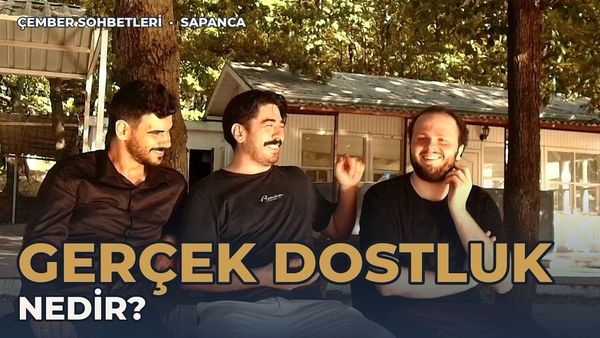 short film from Sapanca · 2 min read · 4 min talkWhat Is True Friendship?One question by the lake, three different answers.
circle rule
This conversation followed the Circle Method: no one interrupts anyone, there's no right or wrong, everyone speaks in turn.